
Setting the right price points for children's clothing requires balancing multiple factors that are unique to this market segment. As a manufacturer working with brands across various price tiers, I've seen how strategic pricing can determine a collection's success or failure. The children's apparel market spans from budget-conscious basics to luxury specialty items, each with distinct consumer expectations and competitive dynamics.
The key considerations for kids clothing price points include production costs, target demographic purchasing power, competitive positioning, perceived value, and the delicate balance between quality and affordability. Successful pricing strategies must account for children's rapid growth cycles, parental spending patterns, and the emotional drivers behind children's apparel purchases while maintaining sustainable profit margins.
Understanding how these factors interact allows brands to establish price points that resonate with their specific customer base while supporting business growth. Let's examine the critical elements that influence pricing decisions in this complex market.
How do production costs influence pricing?
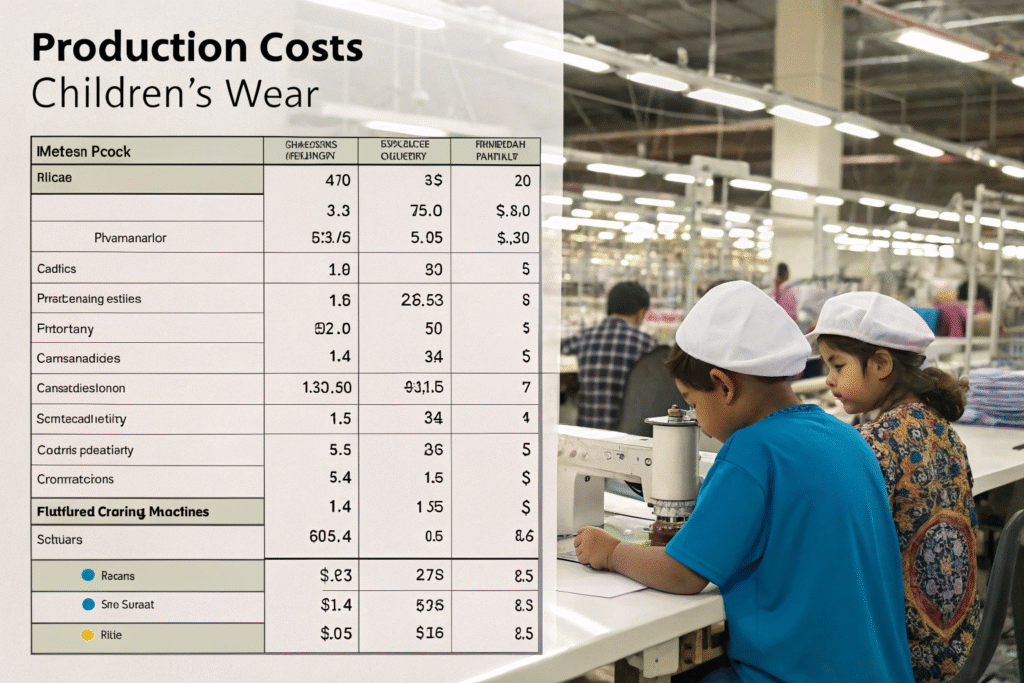
Production costs form the foundation of any pricing strategy, serving as the baseline below which sustainable business becomes impossible. In children's wear, these costs include not only materials and labor but also specialized expenses related to safety compliance, testing, and the technical challenges of smaller-scale construction.
The most significant production cost factors include fabric quality and quantity, construction complexity, compliance testing, and trim details. Children's clothing often requires more intricate construction than adult sizes due to smaller pieces and specialized finishing techniques. Additionally, safety certifications and testing represent a substantial cost that must be distributed across the production run.
Why do safety certifications impact costs so significantly?
Safety certifications impact costs significantly because they require third-party testing, documentation, and often specialized materials that meet strict standards. Each market has its own requirements—CPSC certification for the US, CE marking for Europe—with testing costs that can range from hundreds to thousands of dollars per style. These fixed costs must be amortized across the production quantity, making them particularly impactful for smaller runs. Additionally, certified materials like Oeko-Tex fabrics often carry premium prices, while specialized construction techniques to meet safety standards increase labor costs. Brands must factor these expenses directly into their pricing models to maintain profitability.
How does construction complexity affect final prices?
Construction complexity directly affects final prices through increased labor time, specialized machinery requirements, and higher waste factors. Children's clothing often features intricate details like reinforced knees, growth tucks, and convertible elements that require additional manufacturing steps. According to manufacturing efficiency studies, complex construction can increase production time by 30-50% compared to basic garments. Additionally, smaller pattern pieces generate more fabric waste relative to usable material, while specialized trims and findings—from child-safe zippers to certified buttons—add both material and attachment costs. These cumulative complexities mean that children's clothing often carries higher production costs per square inch of fabric than comparable adult items.
What role does target demographic play in pricing?
The target demographic fundamentally shapes pricing strategy, as different consumer segments have varying perceptions of value, quality expectations, and price sensitivity. Understanding your specific customer's spending patterns, values, and purchasing motivations is essential for setting prices that resonate while maximizing revenue.
Key demographic considerations include household income, geographic location, values alignment (such as sustainability preferences), and purchasing occasion. The table below illustrates how different demographics approach children's clothing purchases:
| Demographic Segment | Price Sensitivity | Key Value Drivers |
|---|---|---|
| Budget-Conscious Families | High | Durability, versatility, growth accommodation |
| Middle-Income Parents | Moderate | Brand reputation, style, quality-to-price ratio |
| Affluent Consumers | Low | Exclusivity, designer names, special features |
| Eco-Conscious Buyers | Variable | Sustainable materials, ethical production, longevity |

How does income level affect price acceptance?
Income level significantly affects price acceptance by determining both the absolute price points consumers can afford and their perception of value at different price levels. According to consumer spending data, households in the top income quintile spend approximately three times more on children's apparel than those in the lowest quintile. However, price acceptance isn't solely about affordability—it's also about alignment with self-perception and social signaling. Higher-income consumers often associate premium pricing with quality, safety, and status, while budget-conscious shoppers prioritize practical considerations like durability and growth accommodation. Understanding these psychological dimensions helps brands position their pricing within acceptable ranges for their target demographic.
Why do geographic markets require different pricing approaches?
Geographic markets require different pricing approaches due to variations in purchasing power, competitive landscapes, distribution costs, and cultural attitudes toward children's products. The same item might command a 40% price premium in Scandinavian markets compared to North American prices due to higher disposable income and different value perceptions. Meanwhile, emerging markets might require adapted sizing, styling, and pricing to match local preferences and economic conditions. Additionally, import duties, shipping costs, and currency fluctuations all impact the final retail price in different regions. Successful global brands develop market-specific pricing strategies that account for these variables while maintaining brand positioning consistency.
How does competitive positioning influence pricing?
Competitive positioning directly influences pricing decisions by establishing reference points that consumers use to evaluate your prices. In the crowded children's wear market, brands must carefully position themselves relative to competitors while communicating their unique value proposition through pricing.
Key competitive positioning factors include brand tier positioning, points of differentiation, and perceived quality markers. Understanding where your brand fits within the competitive landscape—whether as a value alternative, premium option, or specialty player—helps determine appropriate pricing relative to similar products in the market.

What is the role of price anchoring in consumer perception?
Price anchoring plays a crucial role in consumer perception by establishing reference points that make your pricing appear more reasonable. When consumers see a premium-priced item next to an ultra-premium option, the premium item seems more accessible—a psychological effect documented in behavioral economics research. In children's wear, effective price anchoring might involve displaying a signature collection item at a higher price point to make the core collection seem more reasonably priced. Similarly, showing the "price per wear" for durable items versus fast fashion alternatives can anchor value perceptions around longevity rather than initial cost. Understanding these cognitive biases allows brands to structure their pricing architecture to guide consumers toward optimal price-value perceptions.
How can differentiation justify premium pricing?
Differentiation justifies premium pricing by creating unique value that competitors cannot easily replicate. In children's wear, effective differentiators include technical performance features, exclusive designs, specialized fits, and verified sustainability credentials. For example, growth accommodation systems, adaptive clothing for children with special needs, or scientifically-backed developmental benefits can support price premiums of 20-50% above standard alternatives. The key is ensuring that differentiators are both meaningful to parents and clearly communicated through marketing and in-store experiences. When differentiation aligns with genuine consumer needs and desires, price resistance diminishes significantly.
What psychological factors affect price perception?
Psychological factors significantly influence how parents perceive and respond to children's clothing prices, often overriding purely rational economic considerations. Understanding these emotional drivers allows brands to structure pricing that feels fair and appropriate rather than arbitrary or exploitative.
Key psychological factors include the emotional value of children's clothing, gift-giving associations, parental identity projection, and perceived fairness. Children's apparel purchases often carry emotional weight beyond practical necessity, as parents use clothing to express love, celebrate milestones, and project family values.

Why does emotional value impact price sensitivity?
Emotional value impacts price sensitivity by shifting the purchase decision from utilitarian calculation to expressive investment. According to consumer psychology research, products with high emotional significance—like a child's first birthday outfit or holiday dress—experience reduced price sensitivity as parents prioritize symbolic meaning over strict cost considerations. This emotional connection allows brands to command premium prices for special occasion wear and milestone items that capture meaningful moments in childhood. Understanding these emotional triggers helps brands develop tiered pricing strategies that align with the different roles various garments play in family life.
How do milestone moments affect pricing flexibility?
Milestone moments create pricing flexibility by transforming ordinary purchases into commemorative investments. Items associated with significant events—births, christenings, first days of school, graduations—carry symbolic weight that justifies premium pricing. Parents spending on these occasions are often less price-sensitive because they're purchasing not just clothing but tangible memories. Market analysis shows that seasonal and milestone purchasing drives a significant portion of children's wear revenue at higher average price points. Brands can optimize for these moments through strategic collection timing, special packaging, and marketing that emphasizes the emotional significance of these purchases.
Conclusion
Establishing effective price points for children's clothing requires balancing production realities with consumer psychology, competitive dynamics, and demographic considerations. The most successful pricing strategies acknowledge that children's wear occupies a unique space where practical necessities intersect with emotional purchases and aspirational spending.
By understanding how these factors interact across different product categories and consumer segments, brands can develop pricing architectures that feel fair to parents while supporting sustainable business growth. If you're developing a children's collection and need manufacturing partnership to optimize your cost structure while maintaining quality, contact our Business Director Elaine at elaine@fumaoclothing.com. Let Shanghai Fumao's expertise in children's wear production help you create collections with compelling price-value propositions that resonate with your target market.