
Entering the Australian market with kids' clothing is a significant opportunity, but it comes with a rigorous and non-negotiable set of safety regulations. The Australian Consumer Law (ACL), enforced by the Australian Competition and Consumer Commission (ACCC), mandates strict standards to protect children from potential hazards. Non-compliance isn't just a business risk; it can lead to forced recalls, hefty fines, and irreparable damage to your brand's reputation. As a manufacturer serving global markets, I can attest that understanding and integrating these standards from the design stage is the only path to success in Australia.
To ensure your kids clothing meets Australian safety standards, you must comply with the mandatory Consumer Goods (Children’s Nightwear and Limited Daywear) Safety Standard, adhere to the general product safety provisions of the Australian Consumer Law, meticulously design out hazards like drawstrings and small parts, and maintain a comprehensive evidence trail of testing and due diligence.
The Australian framework is principle-based and thorough. Let's navigate the specific requirements and actionable steps to guarantee your products are safe, compliant, and ready for the Australian market.
What Are the Core Mandatory Australian Standards for Children's Clothing?
Australian regulation hinges on a few key documents that form the backbone of compliance. Unlike some regions with many product-specific rules, Australia's approach focuses on a critical safety standard for nightwear and applies broad safety obligations to all children's items.
The core mandatory standard is AS/NZS 1249:2014 - Children's nightwear and limited daywear having reduced fire hazard. This is a law, not a voluntary guideline. Additionally, all consumer goods, including children's clothing, must be "safe" under the Australian Consumer Law (ACL), which includes managing risks from choking, strangulation, and toxicity.

How Does the AS/NZS 1249 Standard for Nightwear Work?
This standard categorizes garments based on their fire hazard risk and mandates specific labelling and fabric performance.
- Scope: It covers nightwear (pyjamas, nightdresses, dressing gowns, bathrobes, infant sleepbags) and limited daywear (like loose-fitting dresses, robes, or shirts over size 00 often used as nightwear).
- Categories & Requirements:
- Category 1 - Low Fire Danger: Garments that are close-fitting (e.g., snug-fitting pyjamas). Must pass a low flammability test or be made from inherently low-fire-hazard fabric. Labelling is less restrictive.
- Category 2 - Medium Fire Danger: Garments that are not close-fitting (e.g., loose nightdresses). Must be made from fabric that passes a more stringent flammability test.
- Category 3 - High Fire Danger: Garments that do not meet the fabric tests for Cat 1 or 2. These are extremely restricted and must carry a permanent, prominent warning label.
The standard specifies exact label wording and placement. Mislabeling is a common violation.
What Are the General Product Safety Obligations Under the ACL?
Beyond nightwear, the ACL's safety provisions are all-encompassing. Your clothing must be free from defects and not pose any foreseeable risk of injury. The ACCC provides clear guidance on common hazards:
- Drawstrings and Cords: There are specific guidelines (influenced by international standard EN 14682) restricting the use of drawstrings in the hood and neck area for children up to age 7, and in the waist and bottom area for all children's clothing. Functional cords must break away under force.
- Small Parts and Accessories: Buttons, sequins, and appliqués must be securely attached to withstand use and reasonably foreseeable abuse to prevent choking hazards.
- Chemical Safety: Garments must not contain harmful levels of chemicals like heavy metals (lead, cadmium) or certain dyes (azo dyes).
You must exercise "due diligence"—proactively identifying and mitigating these risks.
How to Design and Manufacture for Compliance from the Start?
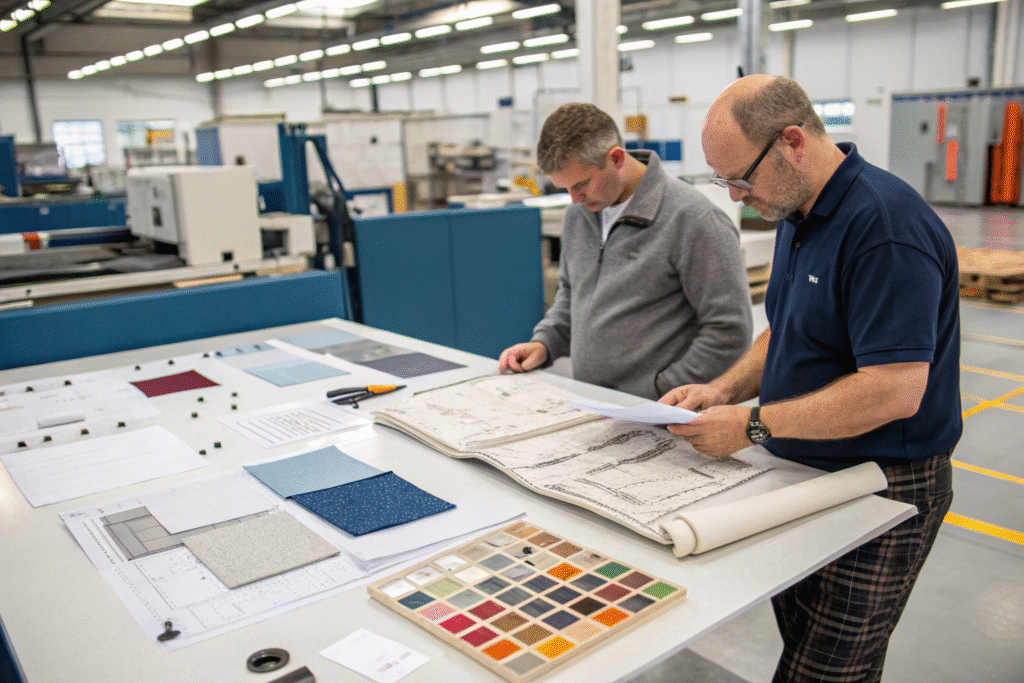
Compliance cannot be tested into a product at the end; it must be designed and built in. This requires a proactive partnership between your design team and your manufacturer, with safety as the first design constraint.
This involves adopting Safety by Design principles, selecting inherently compliant fabrics, engineering safe construction techniques, and ensuring all components (thread, buttons, zippers) are sourced from reputable suppliers who can provide their own compliance documentation.
How to Implement "Safety by Design" for the Australian Market?
This is a procedural shift. Start every design with a hazard review:
- Classify the Garment: Is it nightwear/daywear per AS/NZS 1249? This dictates fabric choice.
- Eliminate Hazards: Can the design function without a hood drawstring? Use alternatives like snaps, clips, or elastic.
- Specify Compliant Materials: For nightwear, select fabrics with known flammability performance. For all items, specify that all dyes and finishes must meet OEKO-TEX Standard 100 or equivalent for chemical safety.
- Secure All Components: Technical packs must specify high-attachment standards for buttons (e.g., bartack reinforcement) and prohibit loose, flimsy embellishments.
Resources like the ACCC Product Safety website provide essential checklists for designers.
What are the Best Fabric Choices for Nightwear Compliance?
The safest and most straightforward path for nightwear is to use fabrics that meet Category 1 requirements by nature of their composition and weight. These include:
- Inherently Flame-Retardant (FR) Fibers: Such as modacrylic blends.
- Tightly Woven, Heavier Natural Fabrics: Like brushed cotton or cotton flannelette of sufficient weight that passes the low flammability test.
- Close-Fitting Garments Made from Any Fabric: If the garment is designed to be snug-fitting (with specific measurements defined in the standard), it can qualify as Category 1 even with standard fabrics.
Your manufacturer must have experience with these fabrics and be able to provide or conduct the necessary flammability testing to verify compliance before bulk production.
What Testing and Documentation is Absolutely Essential?
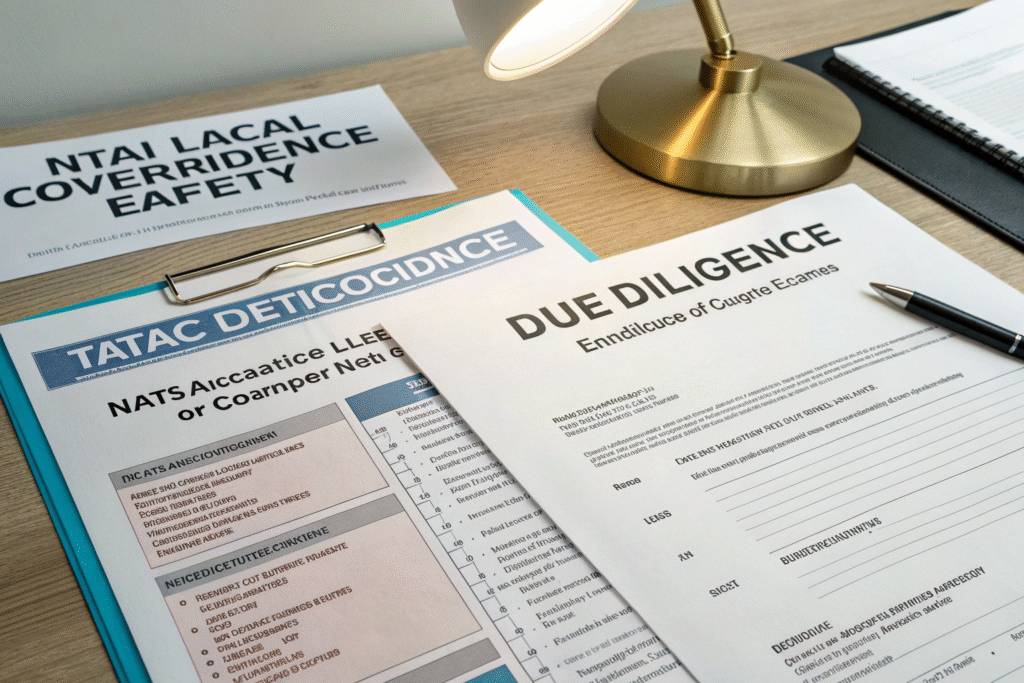
In the event of an ACCC inquiry or a consumer incident, your evidence of due diligence is your primary defense. This is a paper trail that proves you took all reasonable steps to ensure safety. It relies on third-party verification from accredited bodies.
Essential documentation includes test reports from a NATA-accredited or ILAC-recognized laboratory for flammability (AS/NZS 1249) and chemical safety, component supplier declarations of conformity, detailed technical files for each product, and records of your risk assessment process.
Where Must You Get Your Products Tested for the Australian Market?
Testing must be performed by a laboratory that is accredited for the specific Australian standard. Look for:
- NATA Accreditation: The National Association of Testing Authorities, Australia, is the primary local accreditor.
- ILAC Mutual Recognition Arrangement (MRA): Many international labs are part of this agreement, meaning their accreditation is recognized in Australia (e.g., labs accredited under ISO/IEC 17025 by an ILAC member body).
Do not accept test reports from non-accredited labs. You must verify the lab's accreditation scope includes AS/NZS 1249. Reputable global labs like SGS or Intertek have specific services for Australian compliance.
What Should a Compliant Technical File Contain?
For each product style, maintain a file that includes:
- Product Description & Identification.
- List of Applicable Standards: AS/NZS 1249, ACL guidance on drawstrings, etc.
- Risk Assessment Report: Documenting the design-phase hazard review.
- Design Drawings & Specifications.
- Bill of Materials (BOM): With supplier details for each component.
- Test Reports: Full, final reports from accredited labs.
- Proof of Labelling Compliance: Photos or samples of care labels and any mandatory warning labels.
- Manufacturing QC Records.
This technical documentation is your proof of a systematic approach to safety and is critical for both internal quality control and external regulatory audits.
How to Manage Labelling, Warnings, and Post-Market Vigilance?
Correct labelling is a legal requirement and a key part of your communication with consumers. Post-market, you have an ongoing obligation to monitor the safety of your products in use and act immediately if a problem is identified.
Labelling must include mandatory fire hazard warnings for certain nightwear categories, permanent care labels that include fiber content and country of origin, and general information. You must also have a recall action plan and monitor customer feedback and incident reports.
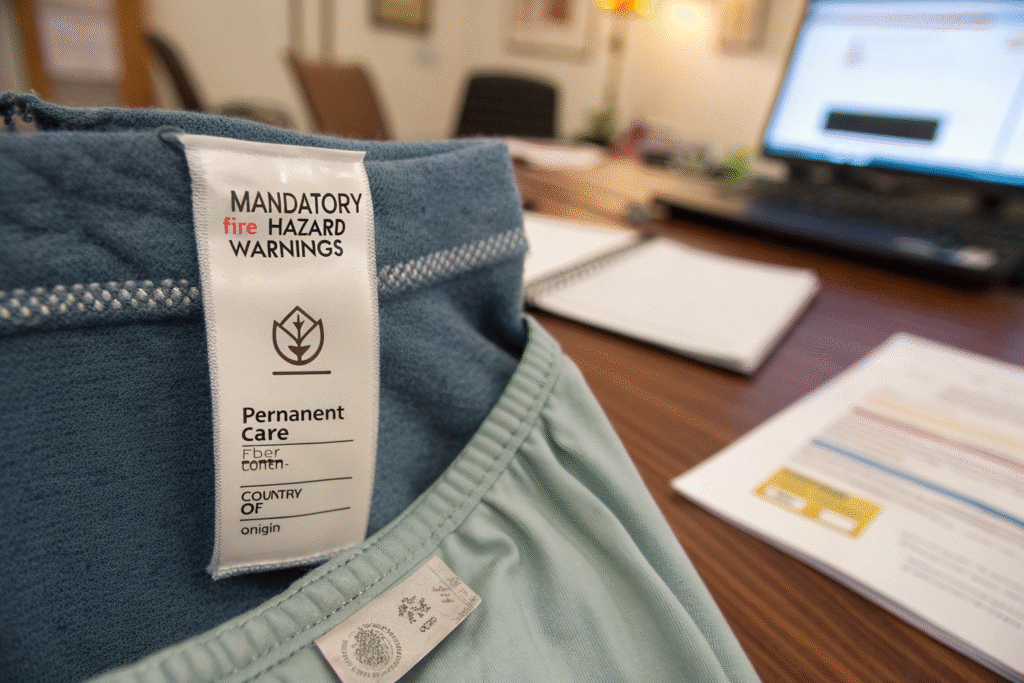
What are the Specific Labelling Rules for Nightwear Under AS/NZS 1249?
The labelling rules are precise and non-negotiable:
- Category 1 (Low Fire Danger): Label must include the words "Low fire danger" in a specific size and format. It does not require the graphic warning.
- Category 2 & 3 (Medium & High Fire Danger): Must carry a prescribed fire warning label. This is a distinctive, red-and-yellow graphic label with specific wording ("WARNING - FIRE DANGER - KEEP AWAY FROM FIRE"). It must be sewn on permanently and prominently (e.g., center back neckline).
- All Garments: Must have a permanent care label with laundering instructions that do not contradict the safety of the garment (e.g., you cannot advise ironing of a plastic-based appliqué that could melt).
The ACCC provides exact label templates and specifications, which your manufacturer must follow meticulously.
What are Your Post-Market Obligations and Recall Responsibilities?
Your duty of care continues after the sale. You must:
- Monitor and Act: Keep records of customer complaints and product returns related to safety. Monitor the ACCC's Recalls Australia website for similar products.
- Have a Recall Plan: Know the steps to initiate a voluntary recall if a safety defect is found. This includes notifying the ACCC, issuing a public recall notice, and organizing returns/refunds.
- Report Serious Incidents: Suppliers are legally obligated to report to the ACCC within two days if they become aware of a death, serious injury, or illness caused by a consumer good.
Proactive post-market vigilance is the final, critical layer of a robust safety management system.
Conclusion
Ensuring your kids' clothing meets Australian safety standards is a comprehensive process of disciplined design, verified manufacturing, meticulous documentation, and ongoing vigilance. It demands a deep understanding of AS/NZS 1249, a commitment to Safety by Design principles, a partnership with accredited testing bodies, and strict attention to labelling and post-market responsibilities. Viewing these requirements not as hurdles but as the essential foundation of a reputable brand is key to building lasting trust with Australian families.
For manufacturers like Fumao Clothing, navigating these standards is part of our core service for brands targeting Australia. We integrate compliance checks into our development process, source pre-vetted materials, facilitate accredited testing, and ensure labelling accuracy. If you are planning to enter or expand in the Australian market, partner with a manufacturer who understands the landscape. Contact our Business Director, Elaine, at elaine@fumaoclothing.com to ensure your collection is safe, compliant, and successful.