
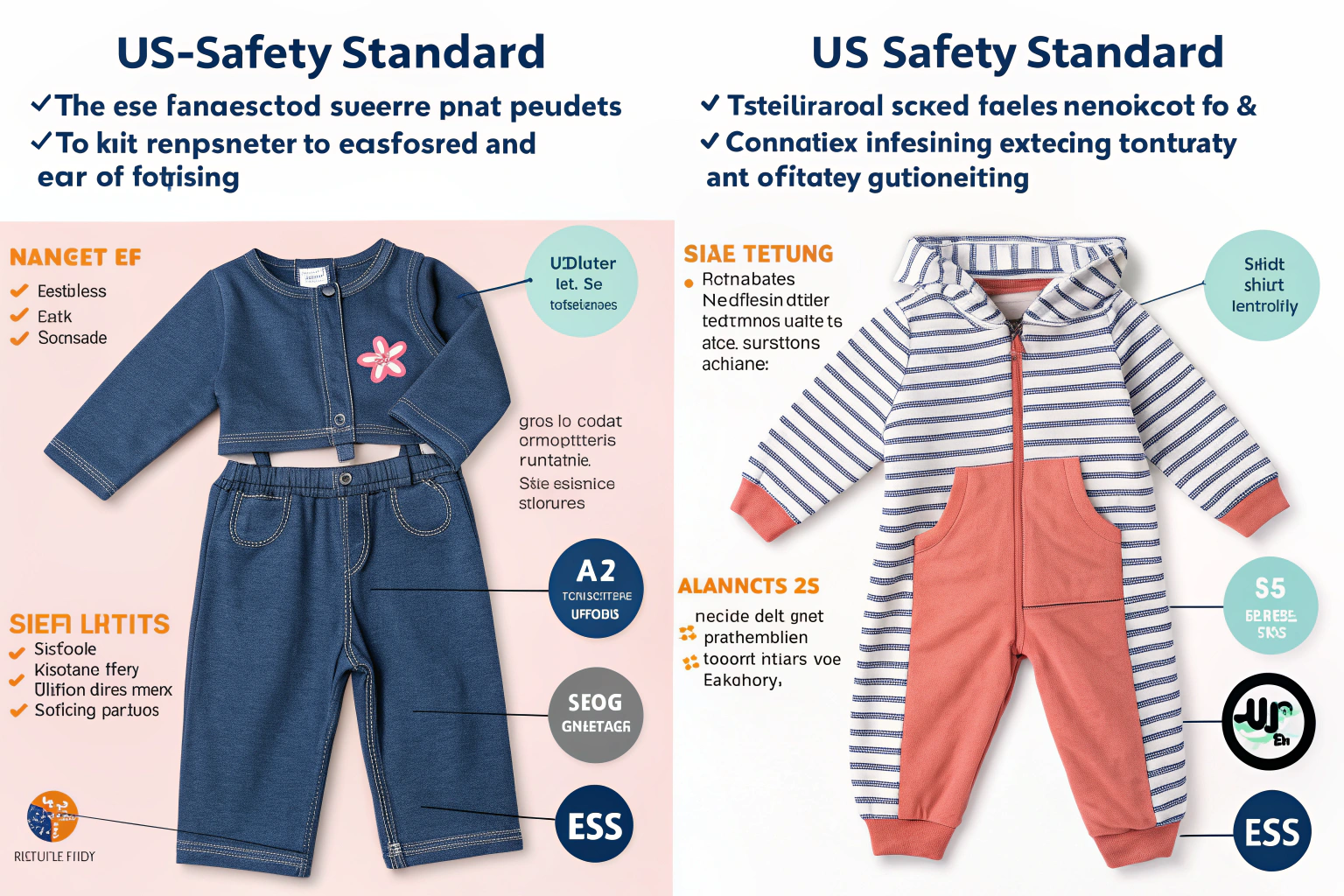
Navigating the complex landscape of children’s product safety standards is crucial for brands operating in international markets. While both the United States and European Union maintain rigorous safety frameworks for children’s clothing, their approaches, specific requirements, and enforcement mechanisms differ significantly. Understanding these distinctions is essential for compliance and successful market entry.
The key differences between US and EU kids safety standards include their fundamental regulatory approaches, specific chemical restrictions, physical hazard requirements, flammability standards, certification processes, and documentation requirements. The US operates primarily through product-specific regulations with third-party testing, while the EU employs a broader framework with manufacturer self-assessment.
These regulatory differences stem from distinct philosophical approaches to consumer protection—the US tends toward specific, prescriptive regulations with mandated third-party verification, while the EU often employs broader principles with manufacturer-led conformity assessment. For children’s clothing brands, these differences impact everything from design decisions to testing protocols and documentation management. Let’s examine the specific distinctions that matter most for children’s wear compliance.
How do the fundamental regulatory frameworks differ?
The United States and European Union have developed distinct regulatory philosophies that shape their approach to children’s product safety, creating different compliance pathways for manufacturers.
The fundamental regulatory frameworks differ through their legislative foundations, certification requirements, enforcement mechanisms, and recall procedures. The US employs specific mandatory standards with required third-party testing, while the EU uses broader essential requirements with manufacturer self-certification. These foundational differences impact how compliance is achieved and demonstrated.
What are the core legislative foundations?
In the United States, children’s product safety is primarily governed by the Consumer Product Safety Improvement Act (CPSIA) administered by the Consumer Product Safety Commission (CPSC). This legislation establishes specific, mandatory standards for various product categories. In contrast, the European Union operates under the General Product Safety Directive (GPSD) and specific regulations like REACH for chemicals, which set essential safety requirements that products must meet, with detailed technical standards often provided through harmonized European Norms (EN standards). The US approach is more prescriptive, while the EU system emphasizes risk assessment and manufacturer responsibility.
How does certification and testing differ?
The US requires mandatory third-party testing by CPSC-accepted laboratories for children’s products, with specific certification requirements (Children’s Product Certificate) that must accompany products. The EU typically relies on manufacturer self-declaration of conformity, where manufacturers conduct their own assessment against applicable standards and create technical documentation. While third-party testing is common in the EU for due diligence, it’s not universally mandated in the same way as under CPSIA. This represents a fundamental philosophical difference in compliance verification.
What are the key differences in chemical restrictions?
Chemical safety represents one of the most complex areas of divergence between US and EU regulations, with different restricted substances, testing requirements, and concentration limits.
The key differences in chemical restrictions include the scope of regulated substances, specific limit values, testing methodologies, and documentation requirements. The EU’s REACH regulation is generally more comprehensive and restrictive than US chemical regulations under CPSIA. These differences significantly impact material selection and testing protocols.
How do lead and phthalate restrictions compare?
The US CPSIA establishes specific limits for lead content in children’s products (100 ppm for substrates) and certain phthalates (DEHP, DBP, BBP permanently banned; DINP, DIDP, DnHP temporarily banned in children’s toys and childcare articles). The EU’s REACH regulation includes these restrictions but extends to many additional substances across multiple Annexes. While both regions restrict similar substances, the EU typically has lower thresholds and covers more chemicals. Additionally, EU regulations often update more frequently with new substance restrictions.
What about other chemical concerns?
The EU maintains more extensive restrictions on azo dyes, nickel, cadmium, and other heavy metals in textiles than the US. The EU’s Ecolabel criteria and Oeko-Tex Standard 100 (while voluntary) represent additional chemical safety benchmarks that many retailers require. The US focuses primarily on lead and specific phthalates for children’s products, with other chemical restrictions being less comprehensive. This means compliance with EU standards often requires more extensive chemical testing and supply chain control than US compliance.
How do physical hazard requirements vary?
Physical hazards like small parts, cords and drawstrings, and sharp points/edges are addressed differently in US and EU regulations, with varying age demarcations and technical requirements.
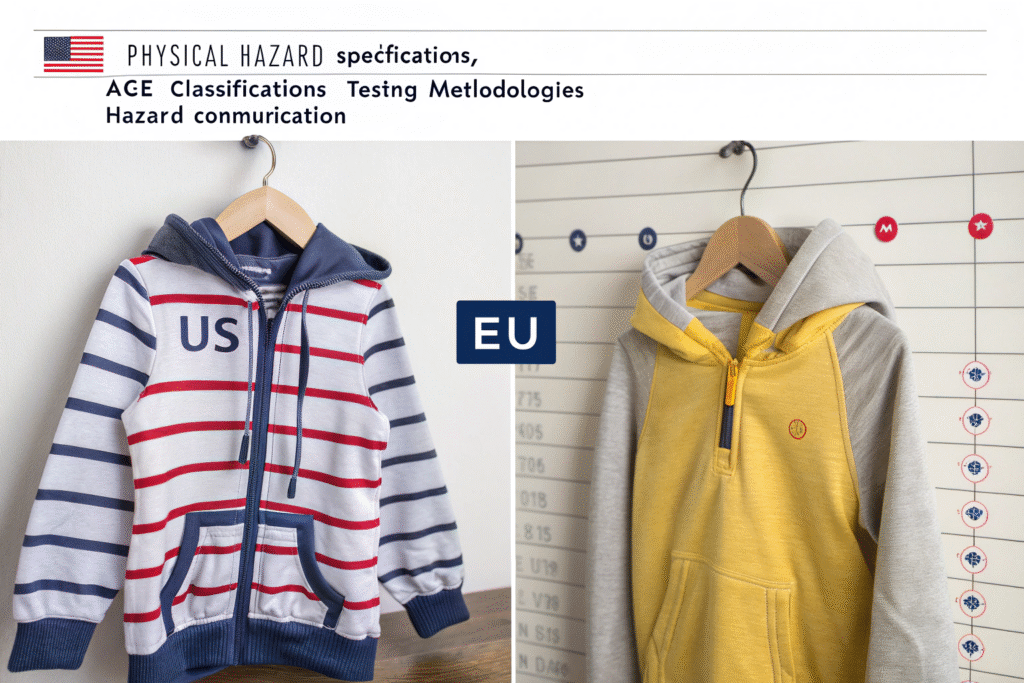
Physical hazard requirements vary in their specific technical specifications, age classifications, testing methodologies, and hazard communication. The US has more product-specific physical hazard regulations, while the EU employs broader hazard-based approaches. These differences impact design decisions, particularly for younger children’s clothing.
What are the differences in small parts regulations?
The US maintains specific small parts regulations for children’s products intended for children under 3 years, using a small parts cylinder test to determine if components present choking hazards. The EU addresses similar concerns through EN 71-1 for toys but has less specific regulation for clothing outside of toy safety directives. However, the EU’s General Product Safety Directive requires addressing choking hazards broadly, creating a less prescriptive but still important compliance consideration. This means US small parts compliance is more clearly defined, while EU compliance requires broader risk assessment.
How do cord and drawstring requirements differ?
The US generally follows ASTM F1816-97 for drawstrings in children’s upper outerwear, with specific recommendations adopted by the CPSC. The EU mandates compliance with EN 14682, which provides more detailed, mandatory requirements for cords and drawstrings in children’s clothing. EN 14682 includes specific measurements, prohibited designs for certain age groups, and test methods. While both address similar strangulation hazards, the EU standard is more comprehensive and explicitly mandatory under the GPSD, whereas the US guidance functions more as an interpretive policy.
What distinguishes flammability standards?
Flammability represents a significant safety concern for children’s sleepwear, with both markets maintaining specific standards, though with different testing methodologies and scope.
Flammability standards distinguish themselves through testing methods, classification systems, scope of application, and labeling requirements. The US maintains specific mandatory standards for children’s sleepwear, while the EU employs a broader general requirement with specific test methods. These differences impact both testing protocols and product design.
How do children’s sleepwear flammability requirements compare?
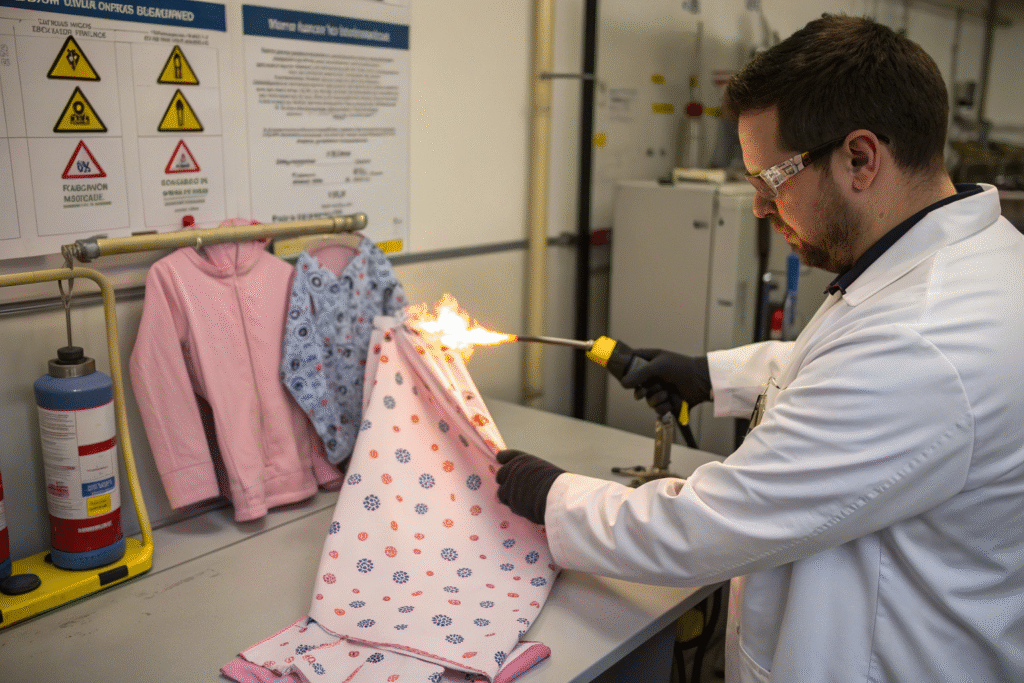
The US maintains specific mandatory standards for children’s sleepwear (16 CFR Parts 1615 and 1616) that include vertical flame tests, specific labeling requirements, and tight-fitting sleepwear provisions. The EU addresses sleepwear flammability through the General Product Safety Directive rather than specific sleepwear regulations, though many manufacturers follow EN 14878 for textile burning behavior. The US approach is more prescriptive with explicit pass/fail criteria, while the EU employs a risk-based approach that considers various factors including a product’s intended use.
What about general wearing apparel flammability?
For general wearing apparel (non-sleepwear), the US follows the Flammable Fabrics Act with specific tests for different fabric types. The EU typically references EN ISO 15025 for protective clothing flammability, but general apparel falls under the broader GPSD requirement for safe products. This creates a significant difference: the US has specific flammability tests for all clothing, while the EU relies on manufacturers to assess and address flammability risks appropriately based on intended use.
How do labeling and documentation requirements differ?
Labeling and documentation represent critical compliance elements that differ significantly between the US and EU markets, impacting everything from supply chain management to market surveillance.
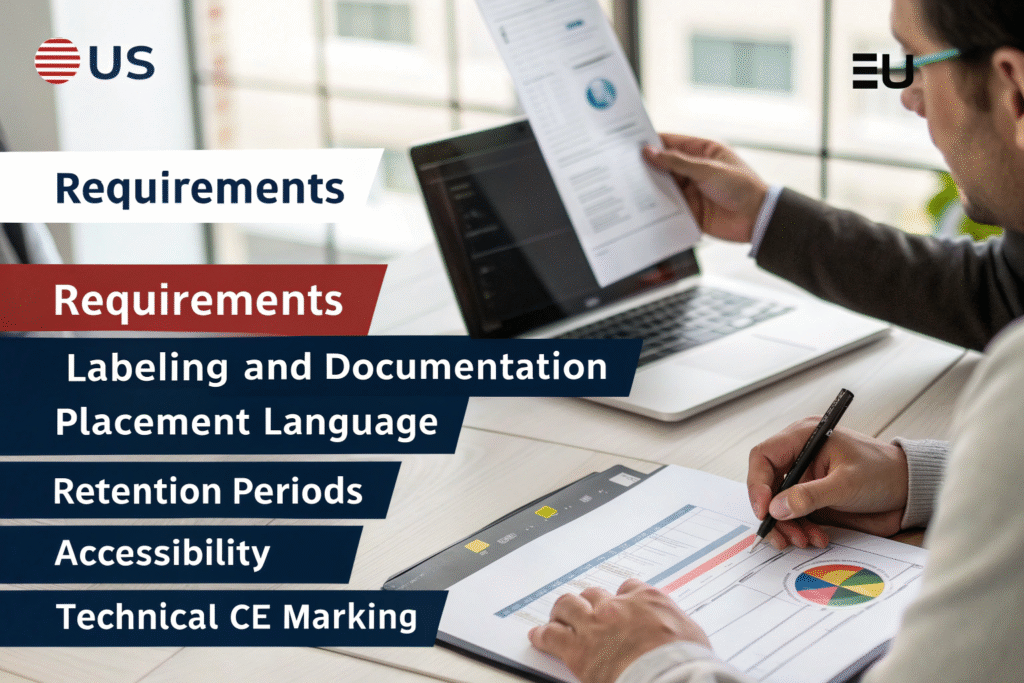
Labeling and documentation requirements differ in their specific content, placement, language, retention periods, and accessibility. The US requires specific tracking labels and certificates, while the EU emphasizes technical documentation and CE marking where applicable. These administrative differences create distinct compliance workflows.
What are the tracking and labeling distinctions?
The US CPSIA requires tracking labels on all children’s products with specific information about manufacturer, date, and production details. The EU requires specific labeling under the Textile Regulation regarding fiber composition, but doesn’t mandate the same tracking information. However, the EU requires clear identification of the economic operator responsible for the product. The US tracking label requirement is more specific and comprehensive for children’s products specifically, while EU labeling focuses more on consumer information than supply chain tracking.
How does technical documentation differ?
The EU requires a technical file for products demonstrating conformity with applicable requirements, which must include risk assessments, test reports, and manufacturing information. This documentation must be retained for 10 years and made available to market surveillance authorities upon request. The US requires a Children’s Product Certificate for each product, referencing applicable tests and standards. While both require documentation, the EU technical file is typically more comprehensive, while the US CPC is a more standardized certificate referencing specific test results.
Conclusion
The differences between US and EU children’s product safety standards reflect distinct regulatory philosophies, with the US favoring specific, prescriptive requirements and mandatory third-party testing, while the EU employs broader essential safety requirements with manufacturer-led conformity assessment. These differences impact nearly every aspect of product development, from design and material selection to testing, documentation, and market surveillance.
For children’s clothing brands operating in both markets, understanding these distinctions is crucial for efficient compliance management. The most successful approaches develop separate compliance strategies for each market rather than attempting a one-size-fits-all solution. This might involve different testing protocols, documentation systems, and even design modifications to meet specific regional requirements.
As both regulatory frameworks continue to evolve—with the US considering updates to various standards and the EU implementing its Strategy for Sustainable and Circular Textiles—maintaining current knowledge of these differences remains an ongoing challenge and competitive necessity for international children’s wear brands.
Need assistance navigating the complex differences between US and EU safety standards for your children’s clothing line? Our expertise includes comprehensive compliance strategies that address both markets efficiently. Contact our Business Director, Elaine, at elaine@fumaoclothing.com to discuss how we can help you achieve compliance in both the US and EU markets.